
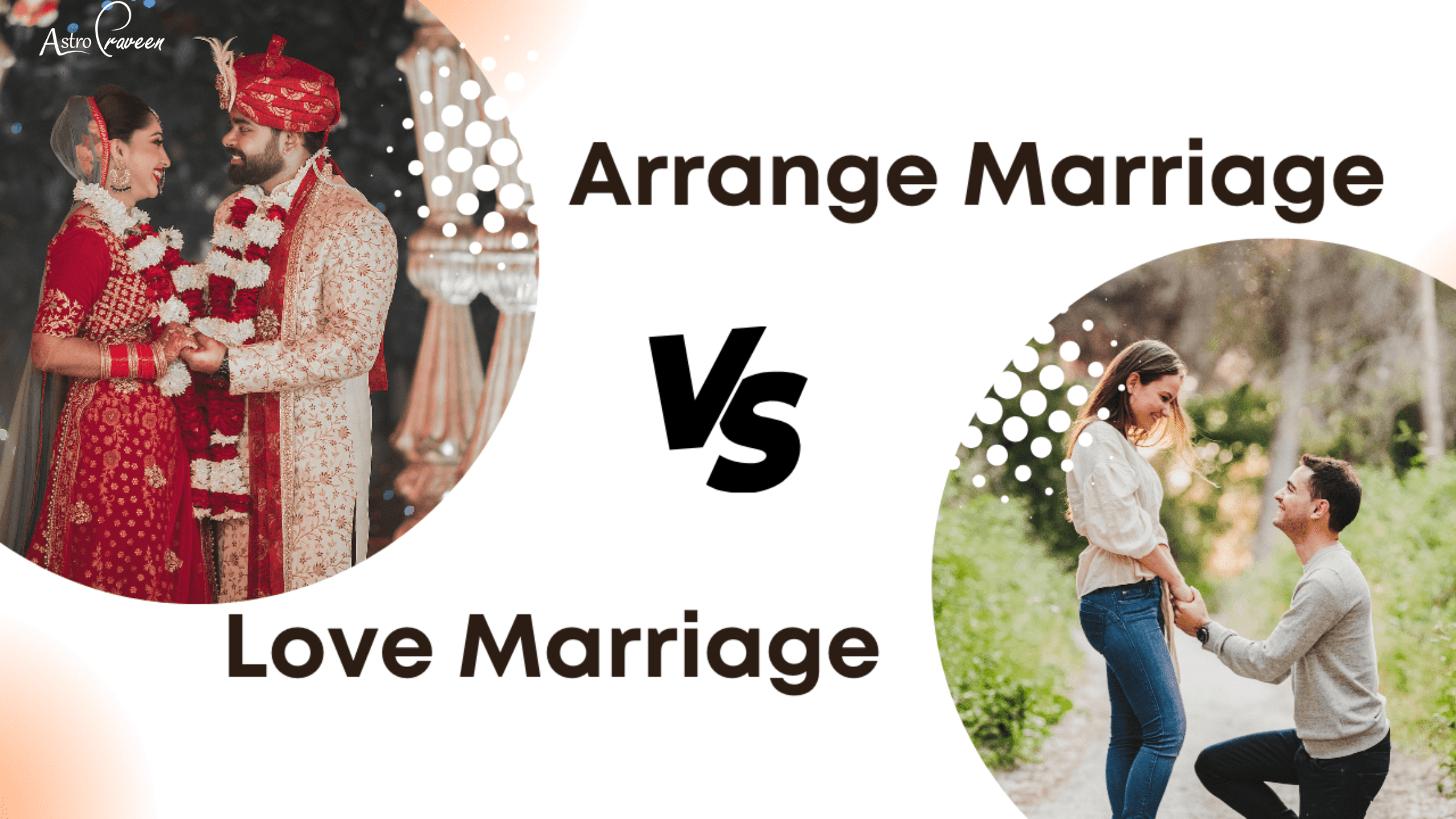
Marriage is one of the biggest life decisions we make. In India especially, the question often arises: should one follow tradition through an arranged marriage, or should one follow the heart through a love marriage?
In this blog, we will explore arrange marriage vs love marriage in depth — comparing them in terms of relationships, happiness, advantages, disadvantages, and even the astrological lens through which many believe destiny plays its part.
We’ll also link to useful astrology services like a kundali milan astrologer, divorce problem solution, love problem solution, and general astrology services to give you a full picture.
Over past decades, India is witnessing a cultural transition. Love marriages are becoming more common, especially in urban areas, while arranged marriages still hold strong in many families and communities. According to some reports, arranged marriages still make up a large share of Indian matrimonies, with many believing they lead to stability and longevity.
At the same time, love marriage vs arrange marriage debate points are hot topics in social circles, counselling, and among astrologers. The choice one makes may have long-term implications — not just for compatibility, but emotional fulfillment, family harmony, and resilience in tough times.
Let’s examine in a structured way how arranged vs love marriage compare.
Here are key dimensions often debated when comparing arrange marriage and love marriage:
| Debate Point | Love Marriage | Arrange Marriage |
| Initial emotional bonding | High from day one; often built on shared feelings, attraction, communication | May start slower; affection, respect, understanding grow gradually |
| Expectations & idealism | Tend to carry romantic expectations; sometimes unrealistic | More pragmatic approach; expectations set more cautiously |
| Family support / social alignment | May face resistance from families, social norms | Usually enjoys strong backing from both families |
| Choice and autonomy | High autonomy — you choose your partner | Moderate autonomy (in modern arranged models) or low in traditional systems |
| Adaptability | Couples may need to negotiate more change and adjustments | Often built-in with expectation of compromise |
| Longevity vs happiness | May offer greater personal satisfaction if partners can adjust | May last longer under social pressure, but not always more satisfying |
From studies: In many love marriages, initial satisfaction is higher, but over time, challenges emerge as ideals confront reality. On the other hand, research on arranged marriages in India has sometimes found that marital satisfaction may be higher or increase over time.
One interesting finding: marital quality isn’t strictly determined by the type (love or arranged). A study suggests that the degree of influence one has over partner selection (especially for women) is a stronger predictor of intimacy, passion, commitment than just whether the marriage was “arranged” or “love.”
So the debate is not binary — many couples fall somewhere in between: they know each other before marriage, families approve, and compatibility is assessed via both emotion and tradition.
In some studies, arranged marriages report higher satisfaction scores. For instance, a Bangalore study found arranged-marriage couples had higher reported marital satisfaction compared to self-marriage couples.
However, other cross-cultural studies (e.g. Indian diaspora) found no significant difference in marital satisfaction between love vs arranged marriages.
These mixed findings show that success is not predetermined by the marriage type, but by how couples manage expectations, communication, commitment, and external pressures.
Let’s dig deeper into how arrange marriage vs love marriage can influence overall happiness, emotional health, and relationship quality.
Couples who have chosen each other may be better equipped to negotiate conflict because they already have communication patterns. But arranged-couples may benefit from stronger family support systems in times of crisis.
As earlier cited, how much influence you have in partner selection matters. Even in an “arranged marriage,” if you feel your voice was heard and your choice mattered, intimacy and happiness metrics tend to be better.
ResearchGate
In families or societies where divorce is frowned upon, couples (especially in arranged marriages) might endure more rather than separate, which sometimes maintains the external appearance of success but may mask internal unhappiness.
Thus, long-term happiness depends more on resilience, adaptability, shared vision than on whether marriage was arranged or by choice.
Since astrology is central to your website, it’s natural to interpret arrange vs love marriage through that lens.
As many astrologers advise: astrology is a tool, not a destiny. It reveals potentials and challenges, but free will, effort, communication, and mutual growth decide the real outcome.
If a Kundali milan astrologer finds mismatch or weak aspects, remedial solutions (mantras, gemstones, pujas) can help resolve or ease obstacles. Also, if love problem solution or divorce problem solution is needed later, astrology can provide guidance on timing or remedies.
An arranged marriage couple in a middle-class family may not have known each other deeply before marriage, but over 5–7 years, through shared rituals, small gestures, and family exposure, their bond deepens. Emotional intimacy, trust, and respect grow, leading to a stable, content partnership.
A couple who dated for years enters marriage believing in perfect compatibility. After two children, job stresses, divergent life goals, or in-law conflicts, cracks appear. If they don’t recalibrate expectations and communication, emotional distance may creep in.
Many modern couples choose a hybrid: they meet a person by themselves, take time to understand, then bring the family into the decision. This gives a balance — autonomy and emotional bonding, plus familial acceptance and support.
These real-life paths often transcend a strict binary divide.
Whether you are headed for a love marriage or an arranged one, here are some relationship tips grounded in astrology, psychology, and experience:
In the end, the debate of arrange marriage vs love marriage is not just about tradition or modernity. It’s about:
So, before choosing a path, pause and reflect:
I invite you — leave a comment below about which path resonates with you, or any personal experience you’d like to share. If you’d like help using astrology to decide or to seek remedies (for love issues, marital tension, or divorce problems), I’m here to guide you — consider exploring Astro Praveen Kumar’s astrology services or kundali milan astrologer consultation.
Ans: There’s no universal “better” option. Happiness depends on compatibility, communication, expectations, support, and sustained effort rather than the marriage type alone.
Ans: In some contexts, love marriages show higher rates of separation, partly because of higher expectations and greater freedom to exit. But results vary across cultures, and many love marriages succeed.
Ans: Yes — astrologers often examine the 5th and 7th houses, Venus placements, Navamsa chart, and combinations to indicate whether a love or arranged path is more likely. But astrology offers guidance, not certainty.
Ans: Build emotional connection, communicate regularly, seek guidance via love problem solution or counselling, and use astrology remedies if needed. The bond can grow stronger over time.
Ans: Absolutely — before taking drastic steps, explore every possibility: open communication, counselling, astrology remedies, mediation. If resolution is impossible, divorce problem solution can guide your path forward.
EXCELLENTTrustindex verifies that the original source of the review is Google. Astrologer Parveen Kumar very good astrologer meri jo bhi samasya. Thi .100% solution mila. Muja. Best astrologer. Thanks you so Mach. Parveen Kumar jiPosted onTrustindex verifies that the original source of the review is Google. Parveen Kumar ji best astrologerPosted onTrustindex verifies that the original source of the review is Google. I strongly recommend Astrologer Praveen Kumar to anyone facing love or relationship issues. He is the Best Astrologer in Ahmedabad, the Best Love Astrologer in Ahmedabad, and an expert Extramarital Affairs Astrologer.Posted onTrustindex verifies that the original source of the review is Google. Very impressed with the astrology reading from Astrologer Praveen Kumar. His predictions were accurate. No doubt he is the Best Astrologer in Ahmedabad and also the Best Love Astrologer in Ahmedabad and experienced Extramarital Affairs Astrologer.Posted onTrustindex verifies that the original source of the review is Google. Very positive experience with Astrologer Praveen Kumar. He explained my problems clearly and gave helpful solutions. Truly the Best Astrologer in Ahmedabad, the Best Love Astrologer in Ahmedabad, and a reliable Extramarital Affairs Astrologer.Posted onTrustindex verifies that the original source of the review is Google. Good astrologer Praveen sirPosted onTrustindex verifies that the original source of the review is Google. Good astrologer Praveen sirPosted onTrustindex verifies that the original source of the review is Google. Good astrologer Very nice astrology praveen sirPosted onTrustindex verifies that the original source of the review is Google. Good astrologer Excellent work praveen jiPosted onTrustindex verifies that the original source of the review is Google. good astrologer very nice astrology Praveen Sir

In the cosmic realm of astrology, where stars align and destinies intertwine, Astrologer Praveen Kumar emerges as a guiding light of wisdom
Mahavir Jayanti par paaiye sahi margdarshan personal
astrology consultation ke saath
© Copyright 2026, Astrologer Praveen Kumar. All rights reserved.
