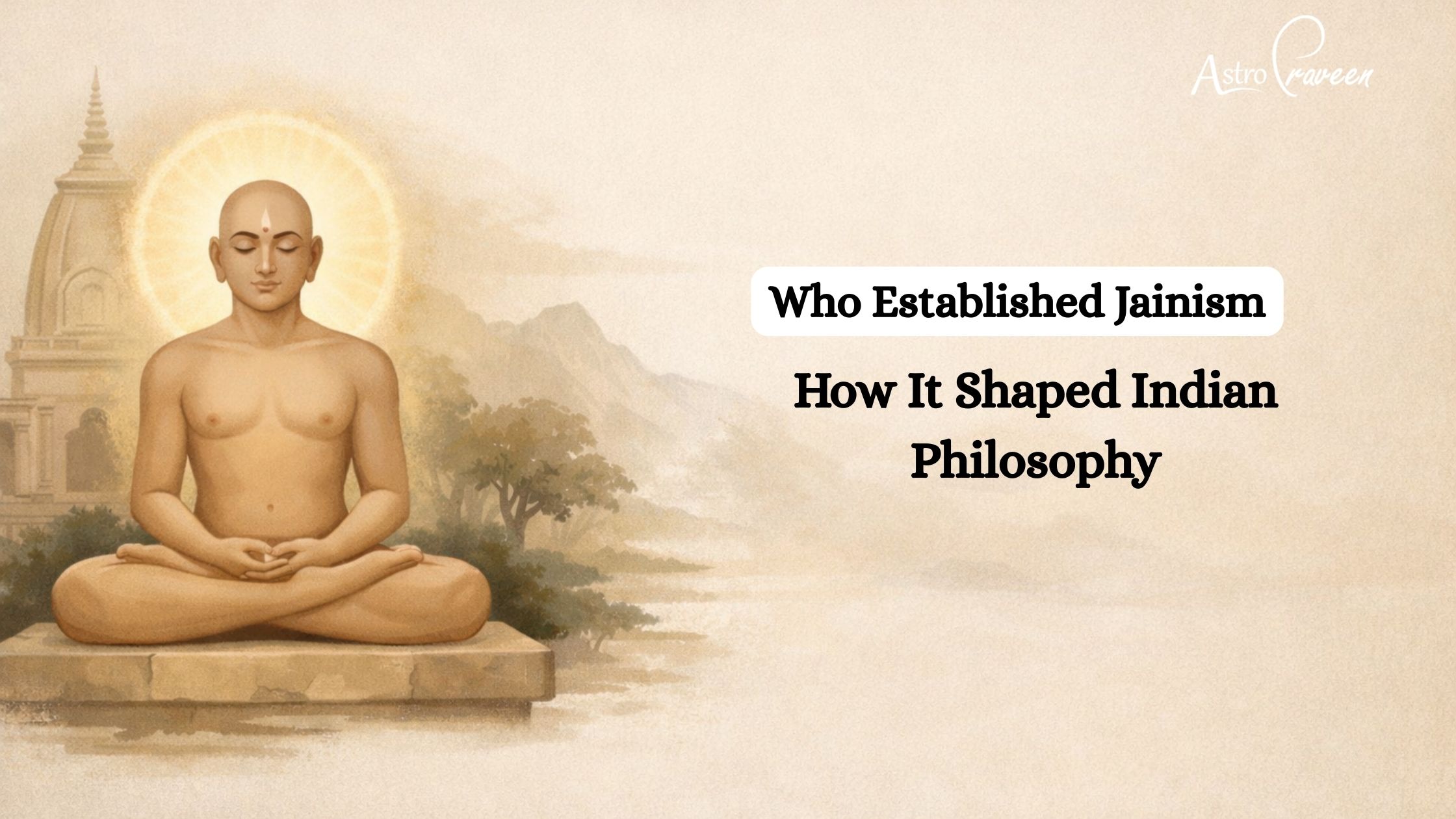
There is something strangely comforting about the old stories we grow up hearing in India. They quietly sit in the background of our lives, shaping the way we think, speak, and even make decisions. Jainism is one of those stories. Not loud, not forceful, just steady and unbelievably resilient. People often ask who established Jainism, maybe imagining a single founder emerging at a historic moment. But the truth, like most things in Indian thought, is layered.
Jainism didn’t begin with one dramatic proclamation or a single enlightened teacher. It evolved through a long line of spiritual guides, known as the Tirthankaras, over many thousands of years. And because of that, Jain philosophy reads almost like a long conversation between ancient souls who spent their lives understanding the nature of human suffering and freedom.
So if you’ve wondered who started Jainism or when Jainism began, you’re already on a path the Jains would appreciate, because questions are the starting point of clarity.
Let’s walk through this story gently, one idea at a time.
Who Established Jainism?
The short answer is that Jainism does not have one founder. Instead, it has twenty four Tirthankaras, each believed to have rediscovered and revived the teachings in different eras. Among them, the first was Rishabhanatha, and the last, far better known today, was Mahavira.
Most people associate Jainism with Mahavira, and it makes sense. He lived in a time of shifting politics, growing cities, and intellectual debates. His teachings became widely accessible and shaped the structure of Jain practice as we know it now. But calling him the founder would be like saying the last chapter of a book is the whole book.
Mahavira refined, clarified, and gave practical shape to an older spiritual stream. Rishabhanatha is considered the first of the Tirthankaras in the current cosmic cycle, and Jain traditions trace the origins of their philosophy back to him. The timeline is vast, stretching far beyond recorded history.
If this feels unusual, remember that many Indian traditions work with long cosmic cycles. Time is seen as circular, not linear, which is why a question like who established Jainism sometimes needs more than one sentence to answer.
When Did Jainism Start?
Historical evidence places Mahavira around the 6th century BCE, roughly the same era as Buddha. But Jain practice and thought are believed to be far older, passed down through oral traditions long before kingdoms and written records became common.
Archaeologists have found symbols similar to Jain iconography in the Indus Valley sites. Of course, nobody can claim these as definite Jain artefacts, but they hint at how ancient the roots of the tradition might be.
So when did Jainism start? You could say around the time of Mahavira if you are referring to the organised religion. Or you could trace it back millions of years according to the Jain cosmic timeline. Both answers sit comfortably in the culture because one speaks to history, and the other speaks to philosophy.
Also Read – How Jainism and Buddhism Differ In Beliefs And Practices
What Jainism Actually Teaches
Jain philosophy is beautiful in its simplicity. It doesn’t try to overpower you with rituals or fear. It quietly asks one question: how can a human being break free from the endless cycle of actions and consequences?
Three principles sit at the heart of it:
1. Ahimsa
Non violence is the most famous Jain principle. It goes far beyond avoiding physical harm. Even harsh words, careless thoughts, or unnecessary consumption are seen as forms of violence. A Jain monk walking barefoot and brushing aside tiny insects is not performing a dramatic ritual. He is practising sensitivity.
2. Aparigraha
This is non attachment. Life becomes clearer when you stop clutching every desire. You start noticing how much energy is spent in trying to hold on to things that were never yours to begin with.
3. Anekantavada
This is the most philosophical of the three. It says truths are many-sided. No one person has the complete picture. Sometimes, while debating with a friend, this idea gently reminds you to slow down and allow space for their perspective.
These three ideas are the reason Jainism has remained calm and steady throughout history. No matter how busy or chaotic the world becomes, a Jain approach always brings you back to the question of how to live with intention.
Jainism Rules That Still Influence Indian Life
Although Jain monks and nuns follow very strict rules, even regular Jain families live with a sense of conscious restraint. Some rules you might recognise:
- Eating before sunset
- Avoiding root vegetables
- Strict vegetarian or vegan food habits
- Careful speech
- Simple living
- Charity offered quietly, without grand display
If you’ve ever had a Jain neighbour invite you for dinner, you’ve probably seen how discipline and warmth somehow sit together beautifully on the same table.
Also Read – When Will You Get Married in 2025-26? Horoscope Insights & Signs
Are Jains Hindu?
This question pops up often, and the answer needs a bit of clarity.
Jainism is not a branch of Hinduism. It is a separate religion with its own scriptures, cosmology, and spiritual lineage. But it is also true that Jain culture grew alongside Hindu culture, and the two share deep philosophical conversations and historical spaces.
They influenced each other, argued with each other, borrowed ideas, and shaped Indian society together. In Indian life, religions don’t sit in isolated boxes. They share the same air. So while Jainism is distinct, it is still very much a part of the Indian cultural family.
How Jainism Shaped Indian Philosophy
Some influences are visible even today.
1. The Indian obsession with karma
Every Indian child knows the word karma long before they understand it. Much of this clarity comes from Jain philosophical depth.
2. Vegetarian culture
If you’ve ever tried finding non veg food in a strong Jain or Gujarati area, you know how powerful this influence still is.
3. Ethical business traditions
Many Jain business families follow a gentle but disciplined work ethic shaped by their principles.
4. Respect for non violence
India’s broader spiritual culture, including movements like Gandhi’s, reflects Jain emphasis on peace and sensitivity.
5. Intellectual humility
The idea that truth has many sides, which lies at the heart of Jain thought, has shaped dialogue-based learning in India for centuries.
Jainism didn’t spread through conquest. It spread because people found peace in it.
How This Knowledge Helps You Today
If you are on a spiritual path or simply trying to understand your purpose, Jain principles offer clarity. Anekantavada helps you approach relationships with more patience. Aparigraha helps you declutter not just your home but your mind. And ahimsa, even when practised imperfectly, gradually softens your life.
Even in astrology consultations, like when you seek marriage prediction, kundali milan, or other astrology services, these philosophical insights often shape how you interpret challenges. They teach you that karma is a journey, not a punishment.
Conclusion
Jainism was not established by one person. It grew through countless lives committed to truth, compassion, and liberation. And because it isn’t tied to a single founder, it feels more like a river than a monument. Always flowing, always calm, always there when someone needs direction.
If you ever feel drawn to understand your own karmic cycles or find clarity about your path, combining ancient wisdom with personalised astrological guidance by an expert like Astro Praveen Kumar can open new doors.
Life becomes gentler when wisdom and self awareness walk together.
FAQs
Jainism was shaped by twenty four Tirthankaras. The first was Rishabhanatha and the last was Mahavira.
- Who started Jainism in the historical sense?
Historically, Mahavira is considered the key reformer who organised Jain teachings for society.
It began as an organised religion around the 6th century BCE but its roots go back much further in Jain tradition.
No, Jainism is a separate religion, though it shares cultural and philosophical spaces with Hindu traditions.
- What are the main Jain rules?
Non violence, non attachment, truthfulness, disciplined eating habits, and simple living.